Formatting & Design
How to Make an Audiobook for Your Book: Full Guide
LaunchPad Books Editorial ·
To make an audiobook for your book, you prepare a clean manuscript, decide who narrates it, record at broadcast-quality specs in a quiet treated space, edit and master each chapter to platform standards, then distribute it to retailers and libraries. That is the whole arc — everything below is how to do each step well without wasting money or rights.
An audiobook is not just your text read aloud. It is a separate production with its own craft, costs, and revenue stream. Done right, it reaches readers who never sit down with a print book — commuters, walkers, multitaskers — and it can outsell the ebook in some genres. Done carelessly, it gets rejected by retailers or quietly ignored by listeners. Here is how to get it right.
Decide who narrates: the choice that shapes everything
Before you touch a microphone, settle the single biggest decision: who reads the book. This drives your cost, timeline, and quality. There are three realistic paths.
Narrate it yourself
This is the most common starting point for nonfiction, memoir, and self-help, where your own voice carries authority and intimacy. You control the result and pay no narrator fee. The catch is craft — reading aloud for hours with consistent energy, pacing, and zero mouth noise is genuinely hard, and editing your own audio is slow. If your book is dialogue-heavy fiction with many character voices, be honest about whether you can carry it.
Hire a professional narrator
A trained narrator brings performance, character work, and clean delivery that most authors cannot match. You will usually pay per finished hour (PFH) — meaning per hour of final audio, not per hour spent recording. Some narrators instead work on a royalty share, taking a cut of sales rather than an upfront fee, which lowers your risk but gives away long-term income. Casting matters more than people expect: audition several narrators with the same sample passage and listen for whether the voice fits your book, not just whether it sounds nice.
Use AI narration
Synthetic voices have improved sharply and are now a legitimate option for budget-conscious authors, especially for straightforward nonfiction. The major retailers have moved toward accepting or offering AI-narrated titles, though policies and labeling requirements keep changing, so check current rules before you commit. AI is fast and cheap, but it still struggles with emotional nuance, unusual names, and complex dialogue — and many listeners can tell. Treat the output as a first pass to review, not a finished product.
| Narration option | Typical cost | Best for | Main trade-off |
|---|---|---|---|
| Narrate yourself | Gear plus your time | Nonfiction, memoir, author brand | Steep skill and time demand |
| Professional narrator (PFH) | ~150 to 400+ dollars per finished hour | Fiction, premium quality | Higher upfront cost |
| Royalty-share narrator | No upfront fee, shared royalties | Low-budget launches | Long-term income given away |
| AI narration | Free to modest per-title fee | Tight budgets, simple text | Limited emotion and nuance |
Prepare your manuscript and script
A clean manuscript is the foundation. Before recording, finalize your text — an audiobook recorded from an unedited draft will inherit every awkward sentence, and fixing it later means re-recording. If your book has not had a professional pass, this is the moment to consider professional editing so the words sound as good as they read.
Then turn the manuscript into a narration script. Decide how to handle elements that do not translate to audio: footnotes, tables, charts, URLs, and image captions. Spell out or rephrase anything visual. Write an opening that states the title and author, and a closing credit. Mark pronunciation for unusual names, places, and technical terms so the narrator never has to guess.
The most expensive audiobook mistake is recording before the manuscript is truly final. Every change after recording means studio time, re-editing, and re-syncing — fix the words first, then capture them once.
Record at the right specifications
Retailers enforce technical standards, and getting them wrong is the top reason audiobooks get rejected. The widely used baseline, set by the dominant distribution platforms, calls for each chapter as its own file, recorded with a consistent measured loudness, a low noise floor, and a short stretch of silence at the start and end of every file. Audio is typically delivered as 192 kbps or higher MP3 at 44.1 kHz.
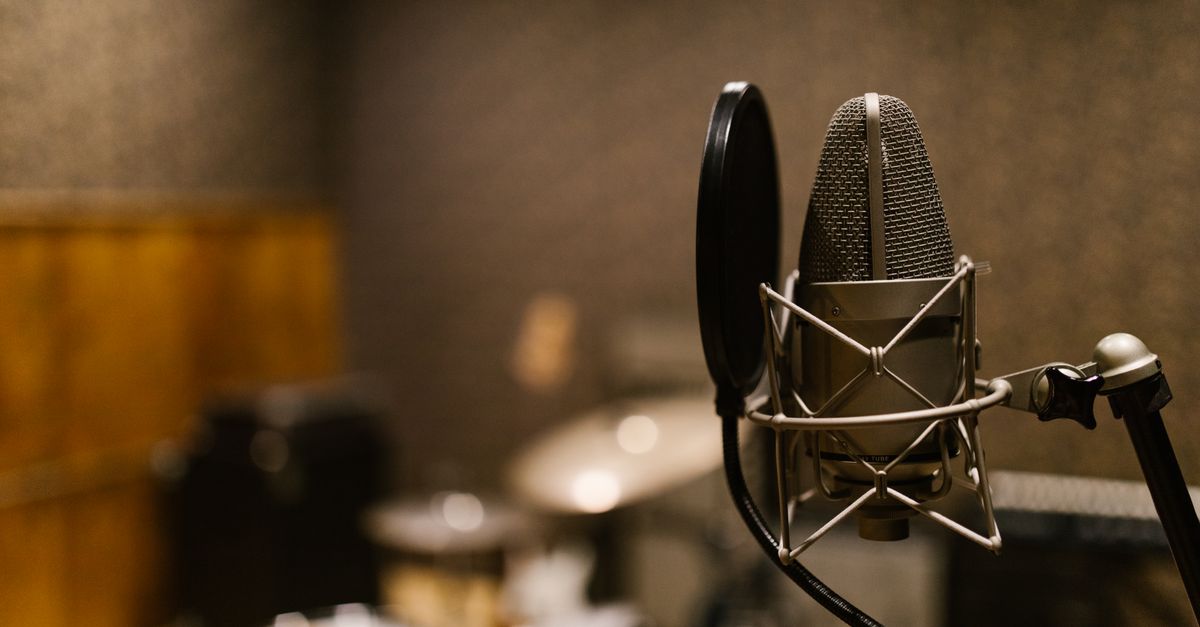
For the recording space itself, treat the room, not just the mic. Soft furnishings, blankets, and acoustic panels kill the echo that screams amateur. A mid-range USB or XLR microphone, a pop filter, and free or low-cost software such as Audacity are enough to start. Record one chapter at a time, leave a beat of silence before each take, and keep your mouth a consistent distance from the mic so volume stays even.
Practical recording workflow
- Warm up your voice and hydrate — tired voices wander in pitch and energy.
- Record in focused sessions; fatigue shows up as inconsistency.
- Punch and roll: when you flub a line, stop, back up a sentence, and continue so editing is clean.
- Keep a take log noting any spots to fix.
- Listen back on headphones for breaths, clicks, and background noise.
Edit, master, and proof
Editing is where raw recordings become a real audiobook. Remove long pauses, stumbles, and noises; even out volume; and apply gentle mastering so the loudness meets platform targets. Each finished chapter should sound consistent with the others — a listener should not notice the seams between recording sessions.
Then do a full proof-listen against the text, ideally with fresh ears or a second person, catching skipped words, repeated lines, and pronunciation slips. This step is tedious and non-negotiable. If editing is beyond your time or skill, this is exactly the kind of work that a dedicated audiobook production service handles end to end, from casting to mastered files.
Distribute, sell, and keep your rights
With finished files in hand, you choose where to sell. The major listening destinations include Audible, Spotify, Apple Books, Google Play, Kobo, and the library platforms that supply public libraries. You can upload to some retailers directly, or use a distributor that pushes your audiobook to many stores at once.
Read the terms carefully, because this is where authors quietly lose money. Some platforms offer higher royalties in exchange for exclusivity, locking your audiobook to a single store. Going wide — non-exclusive distribution across many retailers and libraries — usually means lower per-unit royalties at any one shop but broader reach and more control. There is no universally right answer; it depends on your genre, your audience, and how much you value flexibility.
One principle holds across all of them: understand exactly what rights you are granting and for how long. An audiobook is a durable asset that can earn for years, and signing away too much for a short-term bump rarely pays off. Self-publishing the audiobook on your own terms keeps you in the driver seat, and pairing it with your ebook lets readers move between formats — many will buy both.
| Stage | Typical time | What it produces |
|---|---|---|
| Manuscript prep and script | A few days to a week | Final, audio-ready text |
| Recording | 1 to 3 weeks | Raw chapter audio |
| Editing and mastering | 1 to 3 weeks | Polished, spec-compliant files |
| Proof and corrections | A few days to a week | Final approved audiobook |
| Distribution and review | Days to a few weeks | Live listings on retailers |
What most guides get wrong
Most how-to articles stop at the mechanics and skip the economics. The real question is not only how to make an audiobook, but whether to, and on what terms. Audiobook production is the most expensive format to make and the one where rights deals are murkiest — so the money you save by cutting corners on editing or the income you give up in an exclusive deal can dwarf any gear you buy. Decide your narration path and your distribution strategy first; the recording is the easy part once those are settled.
The other overlooked truth: an audiobook lives or dies on listenability, not loudness or fancy effects. Clean, warm, consistent narration with no distracting noise beats an over-produced recording every time. Aim for the listener forgetting they are hearing a recording at all.
Ready to bring your book to listeners?
Making an audiobook is a real production, but you do not have to navigate casting, recording specs, mastering, and distribution alone. LaunchPad Books helps authors publish, print, and promote their work while keeping every right and every royalty — including full audiobook production and distribution. If you want a clear path from finished manuscript to a polished audiobook selling across every major platform, start your audiobook project and get a tailored quote — keep your voice, your rights, and your earnings where they belong.
Get a cover that sells
Custom cover design and print-ready interior formatting for your book.
Frequently asked questions
How much does it cost to make an audiobook?
Costs vary widely. A professional human narrator typically charges per finished hour (PFH), often in the range of 150 to 400 dollars or more per finished hour, so a 10-hour audiobook can run from roughly 1,500 to 4,000 dollars. Narrating it yourself costs mostly your time plus basic gear, while AI narration can cost from nothing to a modest per-title or subscription fee.
How long does it take to produce an audiobook?
For a typical novel of 80,000 to 100,000 words, expect about 8 to 11 finished hours of audio. Counting recording, editing, proofing and corrections, professional production usually takes four to eight weeks. AI narration can compress this to days, but still needs careful review.
Can I narrate my own audiobook?
Yes. Many authors narrate their own work, especially nonfiction and memoir where the author voice adds authenticity. You need a quiet, sound-treated space, a decent microphone, recording software, and patience for editing. The main risk is underestimating the time and skill that clean, consistent narration demands.
Do I keep the rights to my audiobook?
It depends on how you produce and distribute it. Exclusive distribution deals can lock your audiobook to one retailer and take a larger royalty cut. Going wide through non-exclusive distribution lets you sell everywhere and keep more control. LaunchPad Books helps authors produce and distribute audiobooks while keeping every right and royalty.